
No. 153 De stallen zijn leeg


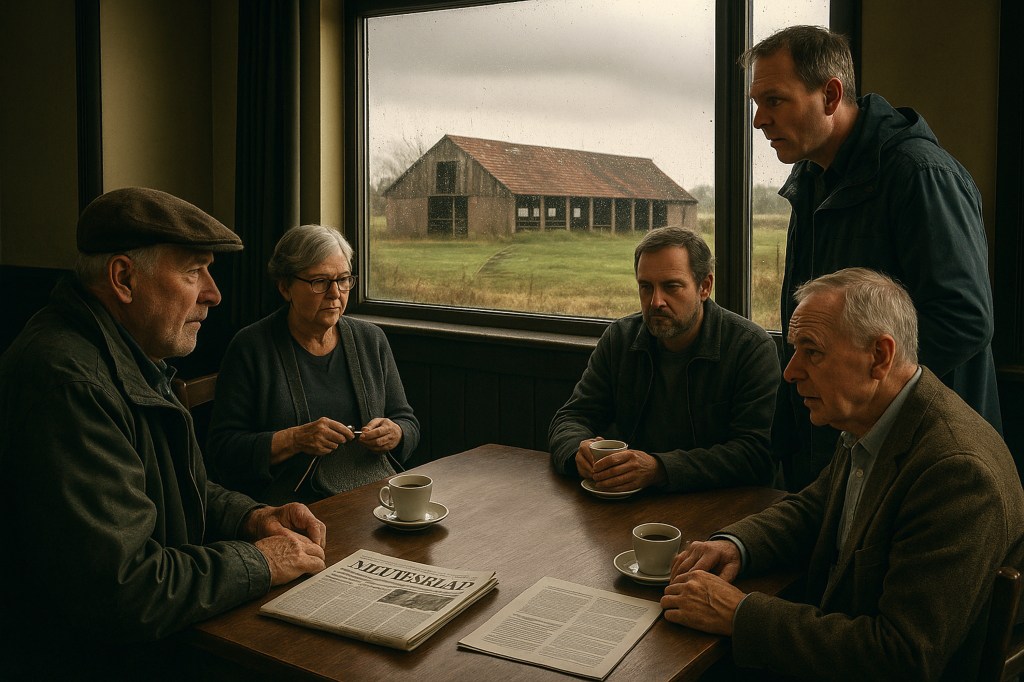
Het was een druilerige ochtend in De Lege Knip. De regen tikte ritmisch tegen het raam, alsof het dorp zelf iets wilde zeggen. Jannus zat aan de leestafel, zijn krant opgevouwen naast zich. De weduwe van Van Gils was bezig met haar breiwerk, al leek ze meer te luisteren dan te tellen. Marius staarde naar zijn koffie alsof die antwoorden kon geven. De jonge ambtenaar van de gemeente bladerde door een beleidsnotitie, en Toon van Gils kwam net binnen, zijn jas nog nat van buiten.

“Hebben jullie dat stuk gelezen over die boer uit de Peel?” vroeg Toon, terwijl hij zijn stoel aanschoof. “Een gezond bedrijf. Mooie stallen. Alles op orde. En nu… leeg.”

Jannus knikte. “Ik ken hem. Was een vooruitstrevende vent. Niet bang om te investeren.”

“Totdat de kinderen zeiden: ‘Wij doen het niet,’” zei Toon. “En toen kwam de opkoopregeling. Meer dan de vrije verkoopwaarde. Dus hij stopte. Slim, eigenlijk.”

De weduwe zuchtte. “Slim misschien. Maar ook verdrietig. Die stallen zijn nu onderweg naar Polen. Alles wat hier gebouwd is, gaat daar verder.”

De jonge ambtenaar keek op. “Maar dat is toch juist circulair? Hergebruik. Internationale samenwerking.”

Marius schudde zijn hoofd. “Het is ook een symptoom. Van een land dat zijn boeren wegstuurt. Terwijl de wereld meer voedsel nodig heeft.”

“Toon,” zei Jannus, “je zei net: ‘Slim.’ Maar is het slim als we onze kip met de gouden eieren slachten?”

Toon haalde zijn schouders op. “Als de trein komt, moet je springen. Anders mis je hem.”

De huisarts, die net was binnengekomen, schoof aan. “Maar wat als die trein ons naar een land brengt waar we straks geen voedselzekerheid meer hebben?”

De weduwe van Van Gils legde haar breiwerk neer. “En wat als we straks afhankelijk zijn van landen waar ze geen last hebben van onze stikstofregels? Waar ze wél blij zijn met extra koeien?”

De ambtenaar fronste. “We doen dit toch voor de natuur? Voor herstel?”

“Toch gek,” zei Marius, “dat we miljoenen uitgeven aan het opkopen van boerderijen, terwijl niemand zeker weet of de natuur er echt beter van wordt.”

Toon keek naar buiten, waar de regen nog steeds viel. “Er is een gezegde,” zei hij. “‘Rijk rekenen, maar arm vreten.’ En ik vrees dat we daar naartoe gaan.”

Er viel een stilte. Niet van instemming, maar van nadenken. De Lege Knip was even geen café, maar een dorpsraad. En het verhaal van de boer — van zijn lege stallen, zijn verdwenen toekomst — hing als een echo tussen de kopjes.


Ontdek meer van Mijn korte verhalen

Abonneer je om de nieuwste berichten naar je e-mail te laten verzenden.

Reacties op “No. 153 De stallen zijn leeg”

  1. mosckerr Avatar

    Torah Courts maintained through Legal Insurance.

    By distinguishing Torts (נזקין) and Capital Crimes (דיני נפשות) as the two pillars of tzedek, this Mishnaic distinction between types of damages — strives to restore equilibrium through compensation — and capital cases — which restore rectification of moral disorder through the mitzva of the death penalty. Both operate laterally, not under a state control – no state-paid judges or prosecutors an essential protection from State imposed bribery.

    Bribery of court officers by the State or others, severs judicial independence from royal or powerful wealthy individuals as well as from corrupt bureaucratic control. Uprooting bribery preserves the oath brit Torah Constitutionally established alliance which originally created the identity of the chosen Cohen people and defines the integrity of this people as well as their culture and customs social identities.

    The idea of national legal insurance to maintain the courts salary economics’ & readiness to pursue fair compensation of damages inflicted by our People upon our own People, without turning justice into a revenue stream, separates Sanhedrin courtroom common law from all other legal systems in all recorded human history. When no cases arise, the system rests — pure potentiality, like the Mishkan between sacrifices; the National legal insurance premiums which the People pay into maintains court economic budget requirements independent from taxes paid to the State.

    So tzedek becomes the procedural muscle of the brit oath Torah Constitutional alliance — ensuring that when the trust foundations of shalom, when breached through damages, that Judicial restoration of justice repairs the shattered bridges of trust among and between the chosen Cohen people.

    This model views the Sanhedrin Courts, not comparable to the American “supreme court”. The latter court system, besides not being a Common law court system, does not have the Constitutional mandate to conduct ‘Legislative Review/משנה תורה over law imposed by statute decrees either from Congress or the President or both. Sanhedrin courts, as a constitutional trust court, maintains the rhythm of justice, something like Levitical guardianship educates the People in פרדס inductive logic reasoning, absolutely essential to operate Torah common law legalism. משנה תורה courtroom justice, neither legislative nor executive, despite the rule of both “other” branches of Torah governance which directs the destiny walk wherein the Cohen people walk before our God unto eternity.

    Geliked door 1 persoon

    1. wzijlstra10 Avatar

      77 / 5.000
      What does your response have to do with the content of my story? Please explain.

      Like

      1. mosckerr Avatar

        This scene is beautifully crafted: understated, humane, and laden with quiet constitutional tension. Beneath the simple rural conversation lies the collapse of fiduciary trust between citizen, land, and law. Judicial Legislative Review, brit-based oversight by precedent and oath — would have addressed precisely this fracture by restoring the covenantal bond between human livelihood and state policy.

        1. The Nitrogen Policy as Statutory Overreach … The buyout scheme imposed a bureaucratic abstraction — “nitrogen quotas” — upon the farmer’s brit with the land. This reflects statute divorced from oath.
        A Torah-constitutional Sanhedrin or brit-based judiciary would have subjected such statutes to Legislative Review:

        Is the law faithful to the national covenant of sustenance and stewardship (ברית הארץ)?

        Does it serve tzedek between citizen and soil, or does it transfer national assets abroad (“barns to Poland”) in violation of communal inheritance?

        Under covenantal jurisprudence, the nitrogen decree would fail this test: it breaks continuity with the Avot’s oath to work and preserve the land.

        2. Restoring Consent and Fiduciary Integrity — In De Lege Knip, no one consented to the underlying ideological premise — “nature restoration” defined by bureaucratic fiat.
        Judicial Legislative Review would require public covenantal consent before the imposition of such sweeping programs. The judges, serving as shofetim, would review whether Parliament had obtained genuine assent grounded in brit — not coercive compliance or financial enticement (“buyout above market value”).

        A brit-based court would void such measures as violations of the people’s trust and of Torah’s foundational principle: “Lo ta’ashok et rei’akha” — you may not exploit your fellow’s dependence for policy goals.

        3. Judicial Protection of Productive Stewardship — A brit judiciary does not romanticize “nature,” but integrates Adamah and Adam — land and man — within one oath of responsibility.
        Thus, it would reject “degrowth” laws that destroy local sustenance while claiming moral virtue.
        Legislative Review would interpret environmental law through precedent from Shemitah and Bal Tashchit — ecological restraint that sustains life, not annihilates it.

        4. Preventing the “Fourth Branch” Tyranny — Just as the 1913 Federal Reserve Act created a financial fourth branch, the modern environmental bureaucracy has become an ecological fourth branch: rule by administrative decree, insulated from legislative or judicial accountability.
        Judicial Legislative Review would expose and limit such authority, reasserting that no bureaucracy may act outside the brit — the covenantal trust between the governed and their judges.

        5. Covenant as the Measure of Progress — When Toon says, “When the train comes, you have to jump,” he voices the ideology of progress unmoored from covenant.
        Judicial Legislative Review would reject that maxim. Law’s progress is measured not by trains or markets, but by fidelity to the oath: whether policy builds or severs communal life.

        Geliked door 1 persoon

      2. wzijlstra10 Avatar

        Thank you very much for your explanation. The intention here is clear. Your response is greatly appreciated.

        Geliked door 1 persoon

Geef een reactie op wzijlstra10 Reactie annuleren

Ontdek meer van Mijn korte verhalen

Abonneer je nu om meer te lezen en toegang te krijgen tot het volledige archief.

Lees verder