
No. 3 De Lege Tafel


De ochtendlucht rook naar regen en asfalt toen Jannus de stoep opstapte richting het gemeentehuis. Hij had zijn map bij zich — een vergeelde plastic ordner waarin hij alles had gestopt: energienota’s, afschriften, sollicitatiebrieven, een boodschappenlijst met in de kantlijn: “per 1 juli geen pindakaas meer”.

Hij had zijn oude schoenen gepoetst met wat vaseline, de boord van zijn overhemd gestreken tussen twee theedoeken en zijn baard met een bot mes wat bijgepunt. Niet omdat hij zich illusies maakte, maar uit respect voor zichzelf. En een beetje voor Trees, die hem had aangemoedigd:

“Ga nou, Jannus. Laat ze maar eens zien dat jij geen sukkelaar bent.”

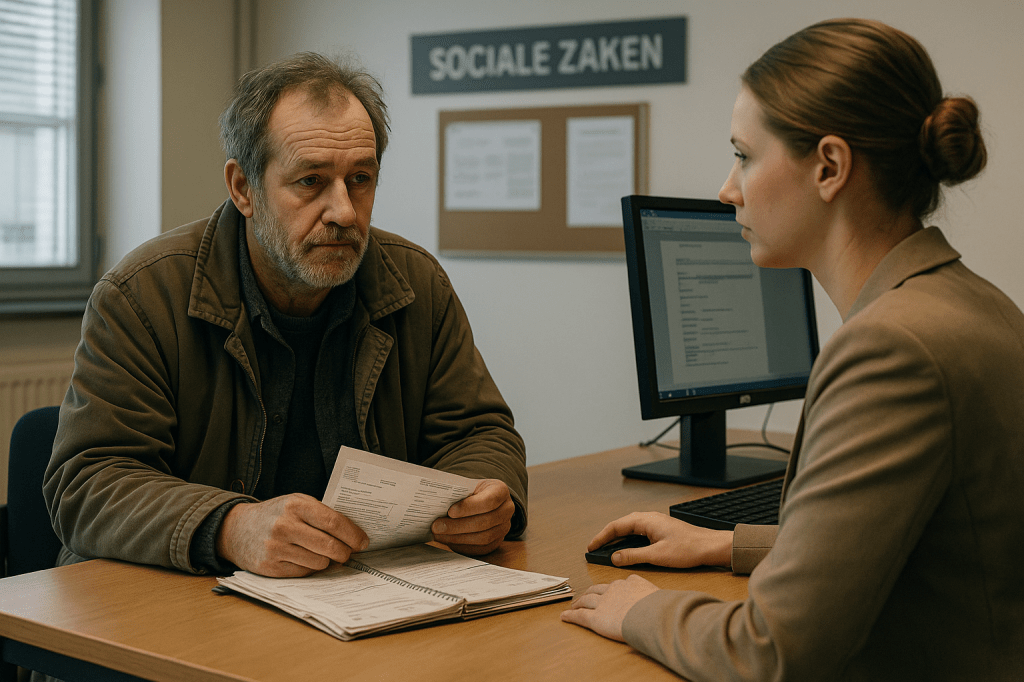
Op de derde verdieping van het gebouw, tussen het loket Woonlasten en het loket Bijzondere Bijstand, zat een vrouw achter een computer. Ze keek op toen hij ging zitten.

“U bent Jannus van der Leegte?”

“Die ja,” zei hij, en legde zijn map op tafel. “Ik dacht, ik kom maar eens uitleggen hoe het werkelijk zit.”

Wat volgde was geen klaagzang, maar een kalme reconstructie van een leven in de marge.
Hij liet haar zijn uitgaven zien, hoe hij nog precies wist wat een pak rijst kostte bij de Aldi en hoe hij zijn was in de douche deed om stroom te besparen.

“Ik rook niet, ik drink niet, ik heb geen auto, geen huisdier en geen kinderen. Alleen een paar boeken en een warme jas van de kringloop. Maar de laatste weken van de maand eet ik crackers met suiker.”

De vrouw zweeg even. Ze was nog jong, met een strak knotje en een blik die meestal automatisch ging bij woorden als ‘armoedeval’ of ‘zelfredzaamheid’. Maar dit was anders. Jannus zat daar niet als een slachtoffer, maar als iemand die zijn kaarten op tafel legde zonder iets te verhullen.

“Ik wil best werken,” zei hij, “maar niemand zit op een man van mijn leeftijd te wachten. En vrijwilligerswerk? Doe ik. In De Lege Knip. Vraag maar na. Ik geef mensen daar boekentips. Soms komen ze speciaal voor mij.”

Ze knikte langzaam.

“U heeft alles goed op orde. Dat is… zeldzaam. Vaak komt men met lege handen.”

“Mijn handen zijn ook leeg,” zei Jannus. “Maar mijn hoofd niet.”

Uiteindelijk kwam er iets uit. Geen wonder, geen gouden brug naar vaste baan of vet salaris. Maar ze kon bijzondere bijstand voor langdurige minima regelen, een aanvullende toeslag op zijn kale uitkering. Hij kwam ook in aanmerking voor een energiecompensatie die hij nooit had aangevraagd omdat hij dacht dat die alleen voor gezinnen was.

Ze gaf hem een lijstje van gemeentelijke werkplekken waar hij als boekencoördinator, taalmaatje of magazijnbeheerder eventueel zou kunnen instromen. “Geen garantie,” zei ze. “Maar u staat nu in beeld.”

Voor het eerst in lange tijd voelde Jannus iets als: erkenning.

Toen hij die middag terugliep naar De Lege Knip, voelde de regen minder nat dan anders. Trees stond buiten te roken onder een afdakje.

“En?”

Jannus haalde zijn schouders op.

“Ze hebben geluisterd. Dat is al wat.”

Trees kneep haar ogen samen tegen de rook.

“Weet je wat dat betekent?”

“Wat?”

“Dat je er nog toe doet.”

Jannus zweeg, maar zijn mondhoek trok iets omhoog.
De koffie smaakte die dag zachter. En het boek dat hij oppakte begon met de zin:
“Het leven veranderde niet ineens, maar met kleine verschuivingen.”


Ontdek meer van Mijn korte verhalen

Abonneer je om de nieuwste berichten naar je e-mail te laten verzenden.

Reacties op “No. 3 De Lege Tafel”

  1. bertjens Avatar

    Zo ongeveer het belangrijkste: er toe doen!

    Geliked door 1 persoon

  2. mosckerr Avatar

    Understanding the Genius of the opening Parsha of the Book of בראשית.

    The study of ancient texts truly requires rudimentary knowledge of the Hebrew language. Reliance upon sophomoric biblical translations compares to a screen door on a submarine.
    בראשית ברא אלהים … בקדמין ברא יי.
    Targum אונקלוס translated אלהים as שם השם. Why? If the foundation cracked, the entire building must come down! The kabbalah of פרדס logic makes no Xtian dogmatic reading of בראשית jailed to “In the beginning”. Such Xtian avoda zarah expresses an Av tumah spirit which defiles as does a dead body in a tent! The concept of רמז – words within words.

    ב’ ראשית … ראש בית … ברית אש words within the word בראשית. Would you give your new born first born child to suckle straight from a sow pig? In the 9th chapter of ברכות rabbi Yechuda interprets בכל לבבך\כם בקריא שמע as serving HaShem with both your Yatzirot tohor vs tuma spirits, which reside in our hearts throughout the generations. The בנין אב\precedent/ wherein rabbi Yechuda introduced this Mishnaic \precedent/ … ב’ ראשית from the opening word of the Torah; two Creation stories comparable to the two opposing Trees in the Garden. A central theme therein introduced from the start.

    Actions have consequences. The Talmud refers to this reality as ירידות הדורות which implies “domino effect or ripple effect”. A great leader makes a decision and all later down-stream generations suffer the consequences! King Shlomo erred and understood בית המקדש as copying the ways of Goyim who build grand Cathedrals and Temples! King Shlomo ignored the council that the prophet Natan gave David just as did Rehoboam ignored the elder councilors of king Shlomo!

    Measure for measure. King Shlomo failed to establish judicial Sanhedrin common law courts as the בראשית of his kingdom! Like Par’o, Shlomo’s “court” tried and judged the Capital Crimes case of the two prostitutes rather than did a small Sanhedrin court in a city of refuge. Actions have consequences, king David failed to rule the case of Bat Sheva’s husband with justice and the prophet Natan cursed his kingdom with Civil Wars throughout its generations. King Shlomo failed to establish Sanhedrin courts and small Sanhedrin cities of refuge, he worshipped avoda zarah as a direct consequence, with g’lut for the people of Yechuda and Israel – the direct consequence.

    גופא — Why did the Torah write אלהים rather than the שם השם? Clearly this question bothered אונקלוס. Rashi addresses the distinctions between judgment and mercy. But this explanation flawed at best, as explained above. The 4th Oral Torah middah רחום learns from the Torah precedents of expunging the nations of Canaan from off the land; the eternal war waged against Amalek/antisemitism; and the דיני נפשות Sanhedrin Capital Crimes case against the משל stubborn and rebellious son; the נמשל the Capital Crimes obligations to expunge wicked evil from the midst of the Israelite nation to prevent the catastrophe of our people worshipping a golden calf like as promoted by the ערב רב that came out of Egypt and failed to develop the tohor middah known as יראת אלהים. The same exact אלהים referenced in the third word of the Torah revelation.

    The language seems obtuse. Why not אלהים בראשית ברא? Answer: Theology\belief systems creates Gods. The Talmud teaches that both Esau and Ishmael rejected receiving the Torah at Sinai. The religions of Xtianity and Islam both create their respected word translation Gods, no different from the sin of the Golden Calf אלהים. Hence the opening creation story introduces the ב’ ראשית of the Yatzir HaRaw or tumah Yatzir, which Rashi references through מדת הדין.

    He falsely depicts this as harsh vs a prioritized מדת רחמים. But based upon the precedents to uproot the kingdoms of Canaan, to eternally war against Amalek and to put to death the stubborn rebellious minor son! The middah of רחום prioritizes חיים over גלות מות, just as Moshe Rabbeinu advised the generation who invaded and conquered Canaan.

    The 2nd Sinai commandment, understood through the Torah precedents which forbid assimilation unto foreign customs, cultures, mannerisms and ways; and another negative commandment against marrying Goyim women whose people never accepted the Torah revelation at Sinai. Both these cardinal Torah transgressions which define the k’vanna of the 2nd Sinai commandment – king Shlomo bathed in the guilt of this Av tuma avoda zarah.

    Therefore, based upon this preamble it appears reasonable to conclude that the Torah introduces the Yatzir טוב מאוד first. Parshat Noach supports this premise. Twenty generations later the Torah now addresses Avram as the father of the chosen Cohen people – as the tohor Yatzir Ha’Tov. The Torah revelation spins around the central axis of distinguishment between tohor vs tuma Yatzir spirits which caused Esau and Yaacov to wrestle within the womb of Rivka.

    Order of birth does not determine who merits to become the Chosen Cohen seed. The tribe of Levi replaced all the first born of Israel following the sin of the Golden Calf! The sin of the Golden Calf duplicated throughout the Xtian bibles and Muslim korans. Impossible to translate the שם השם לשמה, the gospel of John an abomination because his gospel declares word translations as equal to the Divine Spirit Name.

    The critical הבדלה introduced by the Book of בראשית — tohor time-oriented Av-commandments wherein תמיד מעשה בראשית created the chosen Cohen people יש מאין throughout all generations through Torah oaths which through the dedication of tohor Oral Torah middot לשמה sanctify the k’vanna required to create מלאכים שברא יש מאין; and to accept the yoke of the kingdom of Heaven upon these Torah oath created מלאכים as the eternal messengers of both war and peace of the chosen Cohen people.

    Like

  3. meninggever Avatar

    Let op de spam hierboven!! Het verhaal van deze man is wel typerend. Goedwillend, pech hebbend, ongezien levend. Er zijn er meer die dit overkomen. Goed dat er iemand op een sleutelpositie naar hem keek en hem zag, naar hem luisterde en handelde….Dat zijn de kleine wonderen in het mensenleven…

    Geliked door 1 persoon

Geef een reactie op mosckerr Reactie annuleren

Ontdek meer van Mijn korte verhalen

Abonneer je nu om meer te lezen en toegang te krijgen tot het volledige archief.

Lees verder